Brač – the biggest island in Dalmatia region, third biggest in the Adriatic sea. Krk and Cres islands are beating it by only a few square meters. But it is the highest of all islands with its 778m above the sea. From Vidova gora peak the view goes in all directions, even to the furthest Croatian island Palagruža as well as Italy, on a clear day.
Despite its proximity to Split, Brac is less touristed than the glittering islands of Hvar and Korcula further south. No celebrities or tycoons glide their yachts into Brac harbors nor do politicians stroll village steets. For that reason, it provides an excellent window into authentic island life, particularly in the interior.
Although Brač has been inhabited since the Neolithic era, records begin with the ancien tribes called Illyrians. Indeed, the island’s name stems from the Illyrian word Brentos which means deer. The Greeks arrived and named it Elafusa from the word Elaphos which also means deer. The evidences of pre-historic life and settlement on the island can be seen in Kopačina cave, with a short offroad ride and walk to get to it. And in the restaurant of the same name you can taste exquisit tartar beafsteak with a glass of Senjković wine. Locals from Split rush to that restaurant to treat their palates on weekends!
Modest and unassuming Škrip is the heart of ancient BraČ and an essential stop for history buffs. Perched on a hill 2km south of Splitska, Skrip has a population of only a couple of hundred people most of whom are busy raising livestock and producing olive oil. Yet, their history is a proud one.
First the Illyrians settled here to be succeeded by the Romans who quarried stone just outside of town. Stone from the Skrip quarries was dug out by slaves, cut into blocks and sent across the water to be used in constructing Diocletian’s Palace. It was tough work and one slave carved out a figure of the god Hercules in the Rasohe quarry.
Medieval Škrip centers around Radojković’s Citadel, a 16th-century tower that contains the Island of BraČ Museum. Outside are Cyclopean walls that date from the Illyrians. In the lower part of the museum is a Roman mausoleum said to contain Valeria and Priska, the daughter and wife of Emperor Diocletian.
Don’t miss the olive oil in Brač! The olives are of a rare variety called buhavica and there’s over a half-million trees. Olive cultivation dates back to the Venetian years. Back in 1655 the Venetian senate insisted that the island be carpeted with olive trees and imposed fines upon anyone with the temerity to damage the trees. Visit The Museum of Olive Oil to learn about the tools used to process olives into olive oil, and be sure to taste some in its tasting room! Beyond the Olive Oil Museum, there is plenty more gastronomic exploration to do on Brač. The island is also known for its lamb meat, sheep cheese, fishing and agricultural products, wine, figs, mandarins and other fruits.
But the main export is, and has been from ancient times, the famous Brač stone. The settlement of Pucisca is at the middle, northern point of Brac and is famous for its stonework. The white stone that this town was built upon creates a beautiful sight with exquisite architectural works that caught the eye of many leaders, inspiring them to make their own palaces from this stone. Diocletian’s Palace in Split, Sibenik Cathedral, Parliament houses in Vienna and Budapest and even The White House in Washington all have features of Brač stone. The school of stonemasonry in Pučišća has been open since 1909 and takes on around 100 students each year to learn the stonemason craft. Visitors to the school can see the talented students work and see where and how it is created.
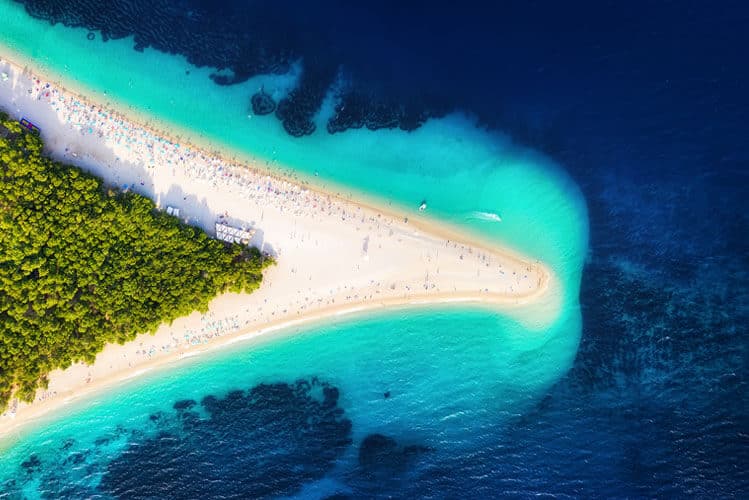
Golden horn beach (Zlatni rat in Croatian language), this natural phenomena has been dazzling people with its changing shape of horn as how the sea currents transfer its sand and pebble stones. Few meters to right, few meters to the left. The best is to see for yourself and enjoy a true Mediterranean beachlife!
40kms in length and 12kms in average width, but with around 200kms of offroads. Every day more and more because as you ride, you see pathways along the side which are not marked in the apps. Better, not everything has to be reachable and known. Those 200kms are forest, military, private pathways or ravines but also easily reachable pathways used for tourist purposes which offer spectacular views over the surrounding islands, places and heritage on the island. There are tours with jeeps, buggies and quads , combined with gastronomical experience of the island. Or you can book the tour with us and ride offroad across the island, enjoy the scents of pine trees and medicinal herbs as we ride the dirt trails… and squeeze the day until its very last end!
Leave a Reply